
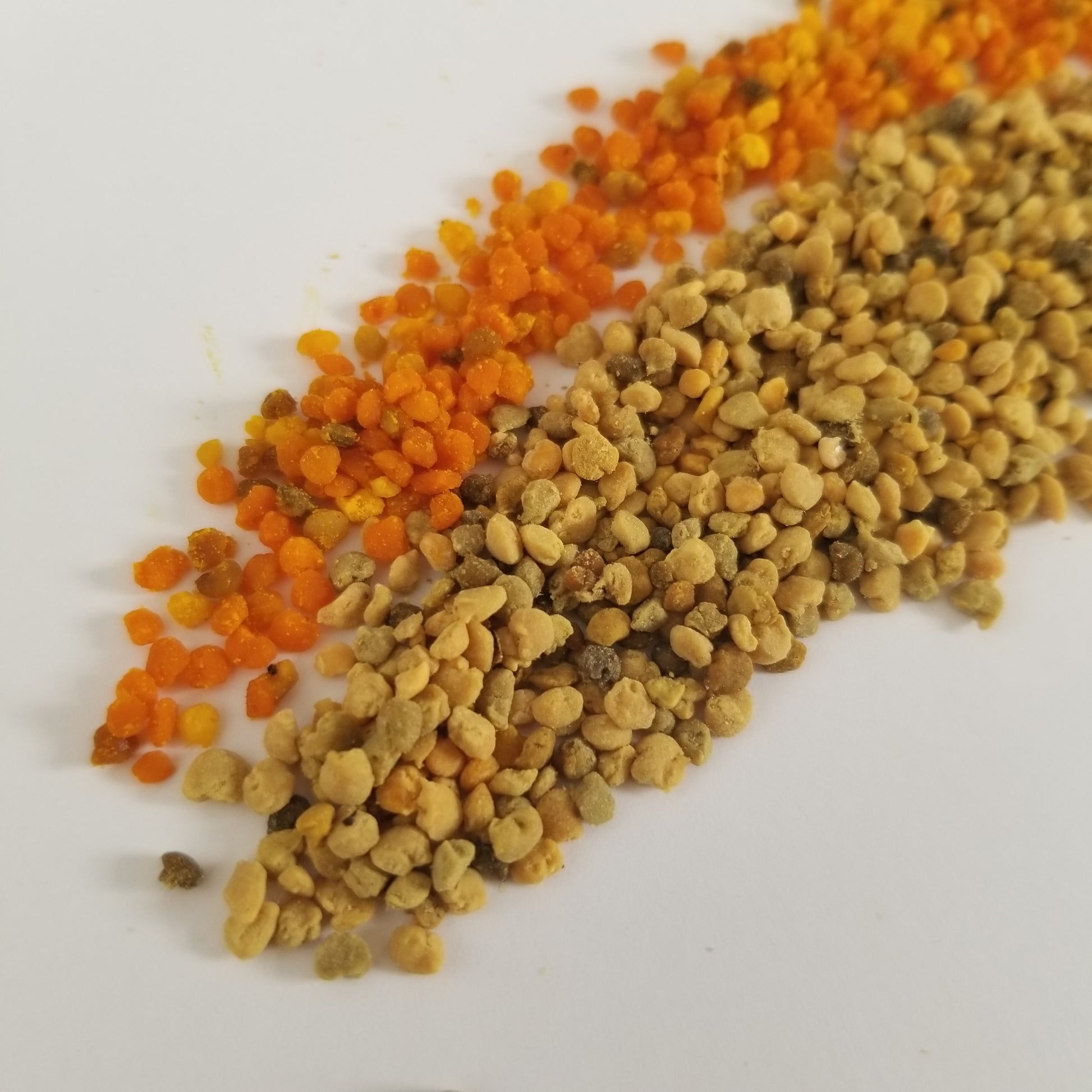

250g Fresh Frozen Pollen
250g Fresh Frozen Pollen
Couldn't load pickup availability
- 250g
- fresh frozen; store in freezer between uses
- Only available for local pickup or Ontario shipping (ships separately from other products via Purolator or UPS Expedited)
Regular consumption of pollen can contribute to health in many ways, reducing inflammation and stimulating the immune & metabolic systems. Pollen analysis has shown that pollen is a storehouse of proteins, essential fatty acids, vitamins, minerals, lipids, sugars, enzymes, carotenoids and bioflavonoids. No other food contains as many elements necessary for life as pollen does. You can learn more about why humans use pollen for health in the drop-downs below!
Why fresh frozen? Fresh frozen allows you to consume the pollen in the same state that the bees collected it. Drying processes can over-dry and over-heat pollen. Over-drying makes it more difficult to dissolve into smoothies, etc. In the case of accidental overheating, the health benefits of pollen are degraded. Fresh frozen pollen can be stored in the freezer and remains easy to scoop out small amounts as needed. It can be safely stored in the fridge for a week or two and can sit at room temperature for several days and up to a week, but should ideally be kept frozen.
When I don't have my own fresh frozen pollen I stock some of my brother's pollen from Nith Valley Apiaries because their pollen is collected from their bees in the same Ellice Swamp area + they also offer it fresh frozen.
Shipping fresh-frozen bee pollen within Ontario is very doable; please read the How I Ship section below to learn more about it!
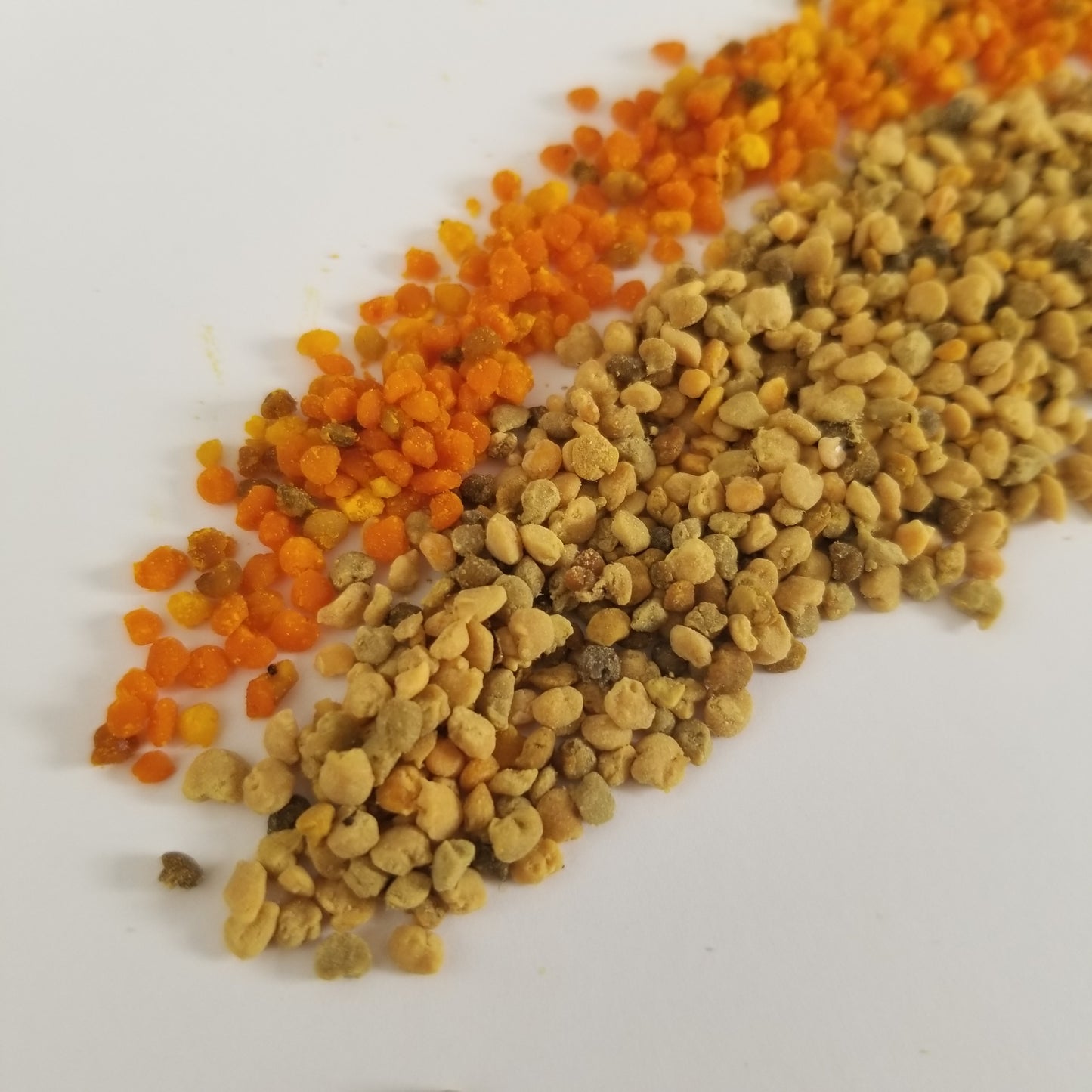

All About Pollen
How I Harvest Pollen
I harvest pollen for a short time each season when the bees have enough extra to share!
- I use a special pollen trap that goes onto the bottom of the hive where the bees enter and exit the hive.
- It collects pollen by gently knocking it off of the bees coming back home and into a screened drawer underneath them. Not all pollen falls off, so the bees still get some for themselves too.
- The pollen gets collected daily for about a week (maybe two) and then I remove it from the hive so that the bees can continue collecting pollen only for themselves.
- Once collected, I winnow and sort the pollen before I jar it and freeze it.
Why do bees collect pollen?
Bees have evolved alongside flowers for many many years. Originally, bees and wasps were quite similar, and over time, bees transitioned to plant-based diets, provided by flowers. The nectar that bees collect and make into honey is their source of carbohydrate, but bees also need protein and fatty acids, and that's where pollen comes in!
Pollen movement is required for flowers to achieve pollination, so it is evolutionarily beneficial for the flower if bees want to transport pollen. Here's how it works:
Bees develop a positive charge from friction of air and dust particles stripping away electrons while they fly. Flowers naturally carry a more negative charge, so that when a bee lands, the negatively charged pollen physically jumps onto the bee, resting as a fine dust on the bee's body hairs.
As the bee moves from flower to flower, it collects more pollen while also dropping off some of the particles as it moves about, causing pollination. Honey bees are generalist pollinators, but they like to visit the same species in a row, which benefits the flowers!
It also benefits the flowers if the bees want to use some of the pollen, because then the bees will visit yet more flowers! Bees collect pollen in special barbed "baskets" on their hind legs by combing it out of their body hairs every so often, packing it securely in their little "panniers" for transport back to the hive. We beekeepers call this the bees' "pollen pants" when we see it!
Another neat feature of the process of pollen (and nectar) transfer is that the flowers' negative charges shift slightly when they are visited by a bee, and that allows the flower to signal to other bees nearby, saying that they have recently been visited and may not provide as much resource to the next bee. How? The bees can use their antennae and body hairs to detect the change in electrostatic charge. Isn't that cool?!
Back at the hive, the bees use pollen to feed the young larvae, which need more protein and fatty acids than an adult bee does. Nurse bees also consume lots of pollen and honey when they need to produce royal jelly, which is also a component of feeding developing larvae.
How is bee pollen healthy for humans?
Regular consumption of pollen can contribute to health in many ways, reducing inflammation and stimulating the immune & metabolic systems.
The nutrients in pollen can help correct metabolic dysfunction and regulate appetite. In addition, pollen’s antioxidants help neutralize free radicals and slow down the aging process. Pollen also helps strengthen capillaries, lower cholesterol levels and boosts liver function. Finally, the well rounded nutrients in pollen help promote mental wellness! You may find that after consuming pollen regularly for two weeks, you notice less “brain fog”.
Pollen analysis has shown that pollen is a storehouse of proteins, essential fatty acids, vitamins, minerals, lipids, sugars, enzymes, carotenoids and bioflavonoids. No other food contains as many elements necessary for life as pollen does.
Pollen contains all 28 minerals that the human body requires for healthy function. Pollen has high levels of vitamins A, B, C, D and E. It is about 35% protein, with half of these in the form of essential amino acids that our bodies easily digest. 40% of pollen is various types of natural sugars, 5% is fats, and 3% is minerals and oligo-elements (which carry minerals). 3% is moisture, and the remaining materials are trace elements such as folic acid and biotin.
Why fresh frozen bee pollen?
Why fresh frozen? Fresh frozen allows you to consume the pollen in the same state that the bees collected it. Drying processes can over-dry and over-heat pollen. Over-drying makes it more difficult to dissolve into smoothies, etc. In the case of accidental overheating, the health benefits of pollen are degraded. Fresh frozen pollen can be stored in the freezer and remains easy to scoop out small amounts as needed. It can be safely stored in the fridge for a week or two and can sit at room temperature for several days, but should ideally be kept frozen.
When I don't have my own fresh frozen pollen I stock some of my brother's pollen from Nith Valley Apiaries because their pollen is collected from their bees in the same Ellice Swamp area + they also offer it fresh frozen!
How long can bee pollen be kept frozen?
Great question! Bee pollen can keep in the freezer for up to 2 years and retain optimal nutritional potency and flavour.
It does remain safe to consume after 2 years, but it may lose potency in the beneficial enzymes, antioxidants and vitamins.
To get the most out of your frozen bee pollen, consider the following:
- Airtight Storage: Always store granules in a tightly sealed, airtight container or a heavy-duty freezer bag to prevent freezer burn and moisture contamination.
- Avoid Thawing: Only take out the amount you plan to use. Repeatedly thawing and refreezing the pollen causes condensation, which can quickly lead to spoilage and mold.
- Shelf Life After Thawing: Once removed from the freezer, it is best to keep the pollen in the refrigerator and consume it within a few weeks.
During shipping, your pollen may thaw. This will be the only time I have removed it from frozen storage, and it will be safe for you to return it to the freezer and maintain the above conditions without reducing it's potency or shelf-life. Check out the How I Ship Frozen Bee Pollen section if you'd like to learn more about shipping specifics.
How Floral Sources Impact Pollen Flavour
The local terroir influences what grows well in a given area, when it blooms, and it can cause variations in flavours due to changes in water and heat from season to season. Thus, the pollen sources, aka flowers, visited by the bees can influence the flavours of the pollen.
Each grain of pollen can have slightly different flavours, and pollen can vary from sweet and floral to having distinctly bitter and sour notes as well!
Often I notice that the pollen I collect tends to be sweeter when it has more orange grains of pollen in it, while pollens that are cream, beige or mustard coloured sometimes have those bitter notes.
Different times of the year and different plants will also yield more sweetness or more bitterness in their pollen. Think of how dandelions greens are bitter to eat, but oh so healthy! Many other plants and trees offer up pollens that have some bitterness to them too, and it's definitely still good for you! If your pollen seems more bitter than you'd like for eating plain, try mixing into a smoothie or adding a little honey along with it!
How I Ship Frozen Bee Pollen
Shipping fresh-frozen bee pollen within Ontario is very doable, but does require extra care. After some trial and error, I have determined that using express shipping is the best option, and thus I've set up a separate shipping profile and shipping pollen will cost more than other products. If you are local, you are welcome to pick it up instead of having it shipped!
I pack the pollen jars with ice packs inside a bubble mailer for extra insulation. However, please note that the pollen may only be cool or may even have reached room temp when it arrives to you. It will not have spoiled during shipping and can be placed in your freezer immediately to return it to its ideal storage condition. As a quick note, I have tested this out by leaving a jar of pollen at room temperature, and it was still good after sitting for a full week. At that point I returned the pollen to my fridge, and it remained there for several weeks with no spoilage.
Express shipping should get your pollen to you within a couple of days so that you don't need to worry at all! Note that the shipping doesn't start until I drop off the parcel at a depot) so your tracking will not necessarily showcase the number of days in transit if I purchase your label the day before I take the parcel in.
Lastly, due to the constraints of shipping a frozen product, I do not ship fresh frozen pollen outside of Ontario.